
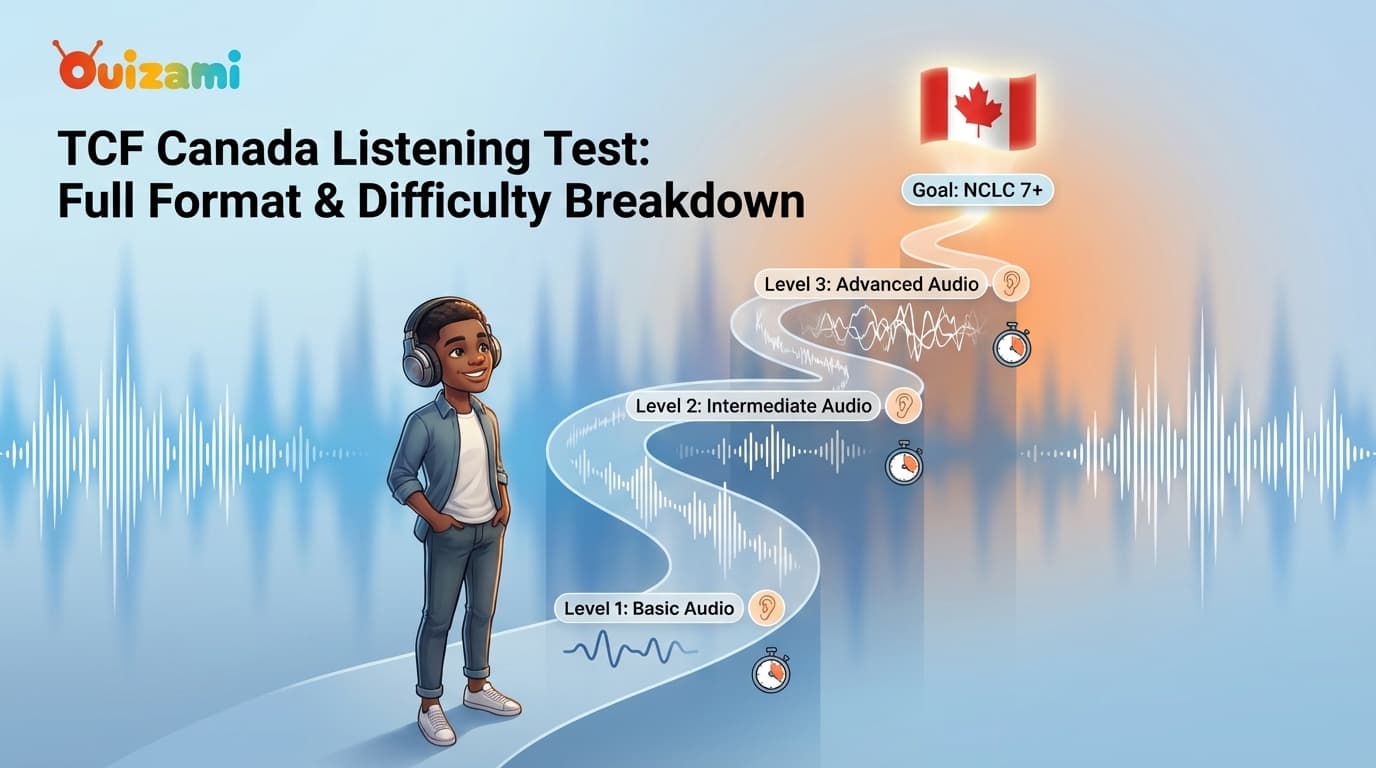
TCF Canada Listening Test (Compréhension Orale): Full Format & Difficulty Breakdown (2025 Guide)
Preparing for the TCF Canada Listening test? This guide explains how the 35-minute section works, why the questions are not written on the screen, and what to expect from the “single listening” rule.
What the TCF Canada Listening Test Really Is?
For many candidates, the Listening Comprehension (Compréhension Orale) is the most intimidating section of the exam. Unlike the Reading or Writing sections where you manage your own time, this section is a relentless, forward-moving sprint.
If you are aiming for CLB 7+ (NCLC 7) for Canadian immigration, understanding the mechanical constraints of this test is the first step to conquering it.
TCF Canada Listening Test Format
The parameters of the listening section are standardized globally by France Éducation international.
Total Duration: 35 minutes
Item Volume: 39 Discrete Items (Questions)
Format: Multiple Choice (A, B, C, D)
Scoring: 0 to 699 points.
The Golden Rules:
️ Only one correct answer per question.
️ No negative marking (guessing is safe).
️ No pause or replay button.
The "Une Seule Écoute" Protocol
The most critical feature of the TCF Listening section is the Single Listening Protocol.
You will hear every audio clip once and only once.
This is designed to simulate high-pressure, real-world communicative situations where asking for repetition is impossible, such as:
Hearing an announcement in a noisy airport terminal.
Overhearing a conversation at a service counter.
Listening to a radio news flash.
Strategic Implication: You cannot "dwell" on a mistake. If you miss a question, you must mentally abandon it immediately. Worrying about the previous answer will cause you to miss the audio for the next question.
The Automatic Pacing Mechanism
In the computer-based version, you do not control the "Next" button.
The audio plays (the scenario and the question).
A timer counts down on the screen.
When the timer hits zero, the screen automatically switches to the next item.
The "Hidden Question" Trap: Crucially, on most questions, the question prompt itself is NOT written on the screen. You will hear the dialogue, then you will hear the question (e.g., "Que veut faire la dame ?"). You will only see the answer choices (A, B, C, D). You must listen for both the story and the specific question.
The Progressive Difficulty Curve
The 39 questions follow a trajectory of difficulty, moving from "Survival French" to "Mastery."
Level 1: The Foundational Tier (Approx. Questions 1–10)
Target: A1/A2 (Beginner)
Audio: Slow, clearly articulated, no background noise.
Content: Basic pragmatics (greetings, numbers, simple instructions).
Level 2: The Intermediate Tier (Approx. Questions 11–25)
Target: B1/B2 (Intermediate)
Audio: Real-world speed with some ambient noise.
Content: Transactions, problems (e.g., a broken item in a store), and social interactions.
The Trap: Distractors. You will often hear the wrong answer mentioned, but then rejected by the speaker (e.g., "I wanted the blue shirt, but actually, I'll take the red one").
Level 3: The Advanced Tier (Approx. Questions 26–39)
Target: C1/C2 (Advanced)
Audio: Fast native speed, overlapping speech, radio interviews, abstract topics.
Content: Shifts from "What happened?" to "What is the speaker's attitude?" (Irony, skepticism, doubt).
Note: This section is the "Critical Zone" for candidates aiming for a high CLB score.
See your scoring guide:
TCF Canada Score to NCLC & CEFR Equivalency Chart
FAQ
1. Are the questions written on the screen? No. Usually, only the four answer choices (A, B, C, D) are written. You must listen to the audio to hear the question itself.
2. Can I go back to change an answer? No. Once the timer expires and the screen changes, your answer is locked.
3. Do all candidates get the same test? No. The test is randomized from a large bank of questions. Candidates in the same room may receive different questions to ensure exam integrity.
4. What score do I need for CLB 7? For CLB 7 (NCLC 7), you need a score between 458 and 502 points. This generally requires getting approximately 60% of the weighted questions correct, including some of the intermediate-level items.
📚Related Resources
Comprehensive test day preparation guide with checklists and procedures
Practical speaking test strategies, warm-up tips, and confidence-building techniques
Detailed breakdown of all three writing tasks with examples and scoring criteria
💡 Study tip: Read these guides together for a complete understanding of the TCF Canada exam format and strategies.
⚖️Important Legal Disclaimer
Last Updated: November 20, 2025
1. Educational Purpose Only: The content on this page, including score conversions and program requirements, is for informational and educational purposes only. While we strive to keep this data accurate, Ouizami is an exam preparation tool, not a law firm or a licensed Canadian immigration consultant.
2. Not Legal Advice: This information does not constitute legal or immigration advice. Using this guide or the Ouizami app does not guarantee specific immigration outcomes, such as Permanent Residence (PR) or Citizenship.
3. Policy Changes: Immigration policies, including TCF score requirements and Quebec regulations (MIFI), change frequently. The requirements listed here may have changed since the time of writing.